Let's play a game.
You are in an empty room. No phone. No laptop. No window worth looking at. Fifteen minutes.
There is one button. Press it and you get a small electric shock. Nothing dangerous. Just unpleasant enough that, five minutes earlier, you told the scientists you would pay money never to feel it again.
Fifteen minutes with your own thoughts. Or the button.
Fifteen minutes is a lot to ask. Try one.
Pressed 0 times
No real shock, no sound, nothing leaves your browser. The minute is on the honour system.
Real scientists ran this in 2014. Two out of three men pressed the button. One in four women did. One man pressed it 190 times. (The study is linked at the bottom, if you do not believe me. I did not.)
I would love to tell you I would have sat there like a monk.
I would have pressed it. Then I would have written a script to press it for me.
The meeting I attended in my sleep
Not long ago we had an internal get-together at work. The kind of meeting where nothing happens, slowly.
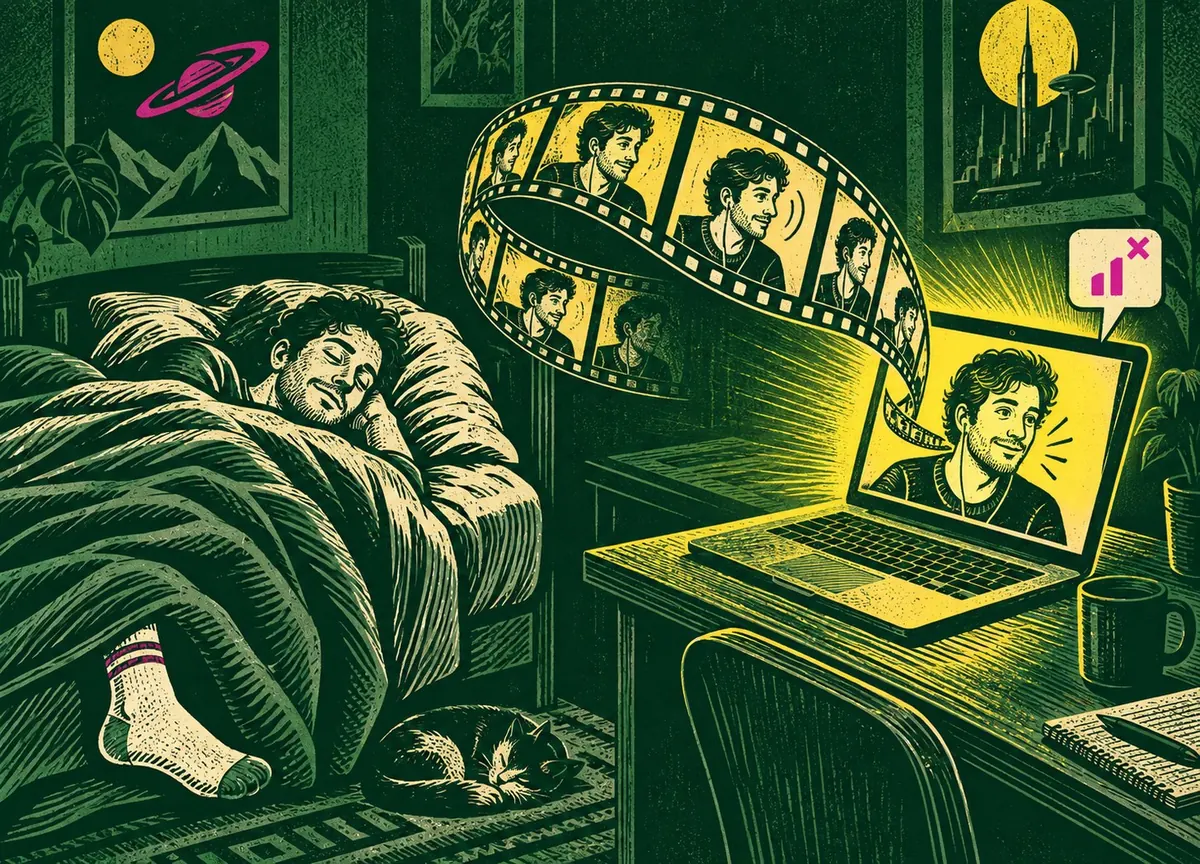
I was tired. So I did what any reasonable person does. I went to bed and sent a video of myself instead. Here is what the team saw.
- Rees joins. Rees is listening. Rees nods at the right moments. Very engaged Rees.
- A few seconds in, Rees's video glitches. Freezes. Dies.
- Rees
Low signal, turning off camera. Please carry on.
- They carry on.
- Teammate
Rees, what do you think?
- Rees
Low signal, mic might not work.
- Teammate
Rees, are you there?
- Rees
Still here. Signal's terrible today, sorry.
- Every time my name came up, a different excuse. Never the same one twice.
- The real Rees, joining after the meeting, in sleepwear
How was the meeting, fellas?
Silence. The what-just-happened kind. Then it dissolved into laughter.
Meanwhile, the whole time, I was in bed giggling like a little girl. Fooled y'all.
One teammate still messages me every few weeks: "Okay, but how did you do it?" I told him to subscribe. He is reading this.
How it worked
Nothing here is hard. That is the point.
Four pieces. One evening. Zero business value.
If your company has a sense of humour, build it. Two rules. Prank people who will laugh. And confess afterwards. The confession is the better joke.
That was version one. Later I gave the twin my voice, then my face, and at Zoom's low resolution nobody suspected a thing. You can sit in a meeting with it on the Lab page, exhibit 06. Join the meeting
Why on earth
Most of my day runs on automations I built. The boring parts especially. Every dull thing I could hand to a machine, I have.
And I was bored out of my mind. Not tired. Bored. The particular boredom of a man whose day runs itself.
So I needed a stimulant. Something stupid, exciting, and mine.
Here is what I did not expect. Building a toy to skip one meeting taught me more than the previous month of "productive" automation:
- How to drive a camera from a script.
- How to make a live transcript trigger an action.
- How to make a machine talk like me without sounding like a machine.
Every one of those is worth money to a business. I found them chasing a giggle.
Friction built it. Boredom built it.
What automation actually steals
Everyone selling automation sells you time. "Save ten hours a week." Fine. Nobody asks where the ten hours go.
They go to the button.
Every hour we free up, we fill with pings. Not with thinking. Pings.
Automation did not take your job. It took your friction. The gap between two thoughts. The wait where ideas used to walk in uninvited.
Here is a test. Open your automations. Read them like a diary. Most people's diary says one word: faster. Mine has a page that says: giggle.
Yes, automation is about shortcuts. But it is more about solving something hard. Or making yourself lazy, which, for a creative mind, is a very good thing.
Lazy people invent. Busy people optimize.
The other Rees
The prank was not my first useless build. It was just the loudest.
A while before it, I gave my team a second "me". On WhatsApp. Same tone. Same impatience. Same jokes, slightly better delivered. You would message it like you would message me, and it would do what I never do: reply instantly.
It read your message. It went online. It waited about as long as a person takes to read a text. Then the little "typing..." appeared, for exactly as long as the answer would take to type, a different length every time. Then the answer landed.
Sometimes it ignored you. Sometimes it just reacted with an emoji. Sometimes you sent five messages in a row and got one reply, to the last one, like a man who finally looked at his phone.
It remembered you, too. Every person got their own memory, so it never asked "sorry, who is this?" and never forgot what you asked it last Tuesday. Which is more than I can say for the original.
The team loved it. They asked it things they would never ask me. Which is your favourite teammate. How do I do this again. Can you explain that thing from the meeting, slower. Help on demand, most of the time. Sass on demand, all of the time.
Here is the part I still cannot get over. Some of them, to this day, do not believe it was not a person.
It ran on a tiny computer the size of a sandwich, sitting on my desk, through a workaround that lets a machine talk to WhatsApp. The sandwich did not enjoy the attention. It crashed. I rebooted it. It crashed again.
But the real reason I pulled the plug is Meta. WhatsApp does not like unofficial clients, and my twin lived on the edge of its rules. So it stays off until that changes.
It solved one small problem of mine: nobody disturbed my focus work. My team still misses it more than they would miss me.
It is yours. Free.
The whole thing, two workflows. Import them, point them at your WhatsApp, give it your own personality (the prompt is in there; make it nicer than mine, or do not). Bring your own AI key. I like you, but I am not paying for your team's jokes.
One warning, and I mean it. Never use this to start conversations. WhatsApp does not like unofficial clients, and a number that suddenly messages strangers gets sent to WhatsApp jail. No bail. This twin only replies to people who message it first. Tell your teammates "this is my new number for random talk", and let the workflow do the rest.
 Iris
Is it safe to run?
 Rees
Said plainly: it runs on WAHA, a free, open-source tool that turns your WhatsApp number into an API. Underneath it runs a real WhatsApp Web, which makes it unofficial. Its makers say so themselves: it shouldn't be considered totally safe.
IrisSo where does it belong?
ReesToys and internal fun, yes. A customer channel on a number you cannot afford to lose, no.
Your turn
Build one automation this week that saves you no time at all. Steal one of these:
- Every morning, one line from your favourite dead thinker, sent like a text from a friend.
- Every Friday, a note to the colleague who quietly saved your week.
- A bot that says "no" to every calendar invite after 6 PM, and lets you overrule it.
- A digital you that your team can bully.
Knowing when to automate is common sense. Knowing when not to is the service.
And sometimes the honest answer is: why not. One of these every Thursday. If this one made you grin, subscribe. If it did not, send it to the colleague who never turns their camera on. They will understand.
Subscribe freeRead the newsletter version
Next storyYouTube AutomationWhat a $149 workflow actually costs.