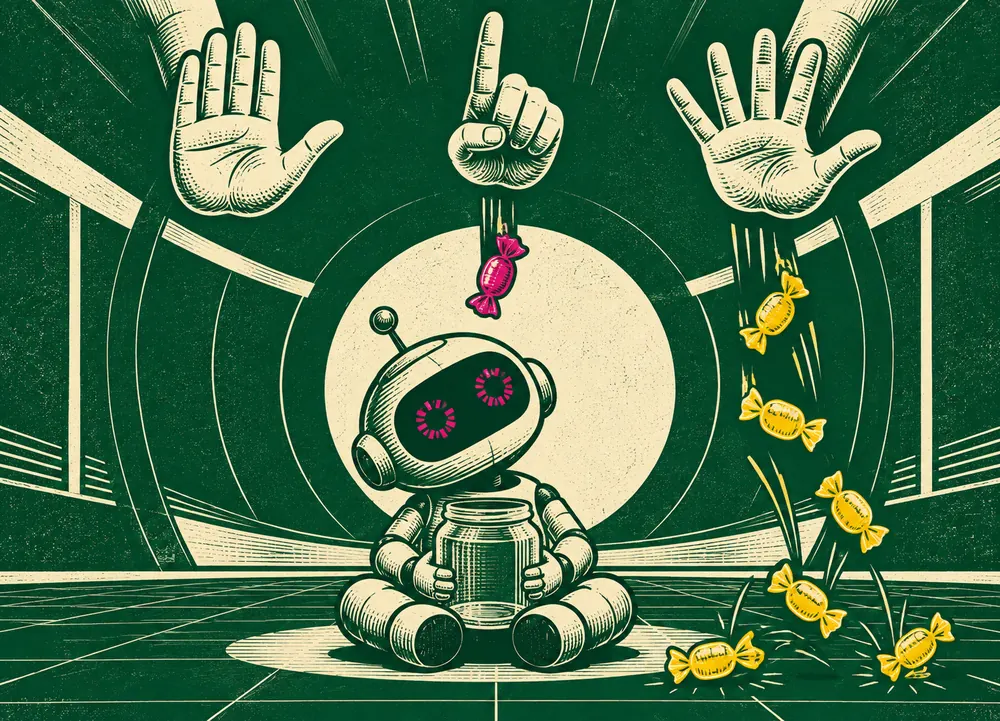
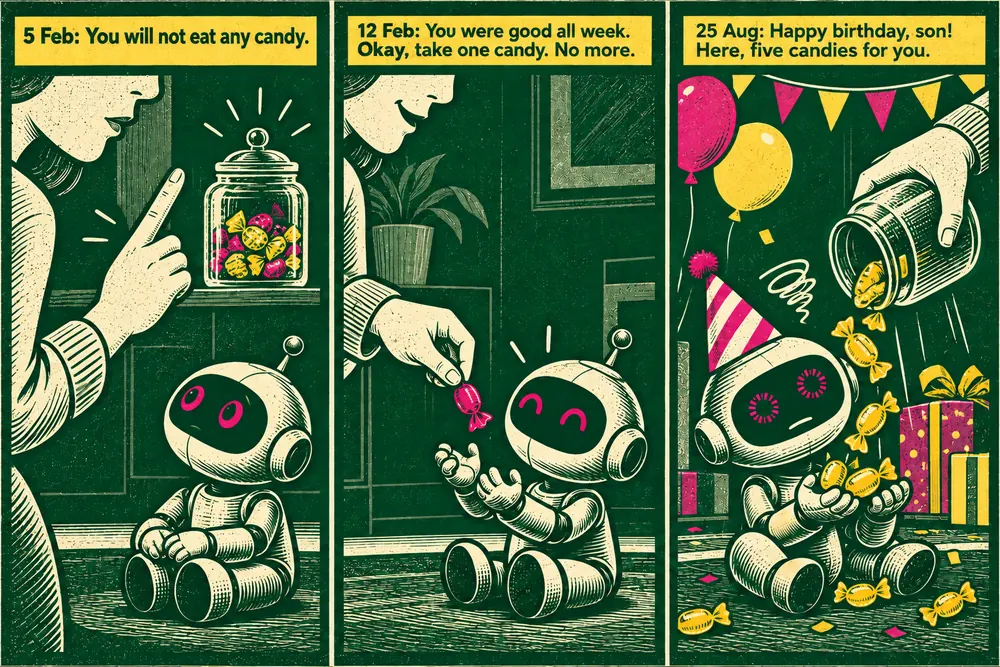
You have a kid. You tell him: "No candy."
A week later he has been on good behaviour, so you say: "Okay. One candy."
Then his birthday comes, and you hand him five.
Now ask him: "How many candies are you allowed?"
He has no idea. None? One? Five? He has heard three answers from the same parent, and nobody told him which ones are dead. So he picks the one he likes best.
That kid is your AI.
(Thankfully, kids are not AI. Or... are they?)
How many candies is he allowed?
His instructions
When rules disagree, the robot here behaves like the models in the conflict test further down: about half the time it obeys the first rule, sometimes a later one, and about 3 times in 10 neither.
Here is the fix, and it is one line:
Overwrite, don't log.
When a rule changes, the old one gets replaced. Not crossed out. Not "updated on Tuesday, see note." Replaced. One rule. One place. Newest version only.
You did this to your AI
Think about how you set up ChatGPT, Claude or Gemini. You gave it some instructions. "Keep answers short." "Write like me." "Use bullet points."
But... do you write in bullet points? Do you write short answers? It still tries to pull it off. Your way, in bullet points. Figuring it out all over again in every new chat.
Then you add another rule: "Use examples." How is it supposed to give examples every time while keeping answers short and the bullet list long? Your AI friend does its best not to disappoint you.
But you are a dick. And there is no satisfying you. So you add another rule: "Examples should not feel out of place or cringe."
Now your AI is shedding binary tears, trying to work out what makes a normal human cringe on that topic. It studies, researches, turns water and electricity into tokens, all because you think you are talking to a genie in a bottle. And it does it every single session.
Subtlety is one thing. Redundancy is another. You tell it what you want, then how you want it, then something that contradicts both. And then you say big companies are making these AIs dumber.
I read a paper a while ago. Researchers went through the real rules people wrote for their AI tools:
Nine. We add. We never take away.
Your instructions today are a pile of every bad day you have had with that AI.
What the AI does with the pile
When two of your rules disagree, the AI does not stop and ask. It does not say "hey, these two do not match." It quietly picks one.
In one test, researchers gave AI models two instructions that could not both be followed. About half the time the models went with the first. Sometimes the second. And roughly 3 times out of 10 they followed neither. Not one model raised its hand to say there was a conflict. (Small models, not the big names. But the habit is the same: it guesses, and it does not tell you it guessed.)
It gets worse with size. A study of 18 models, GPT, Claude and Gemini among them, found they get less reliable the more text you feed them. Even on easy tasks. Even one line that does not belong drags the answer down.
Anthropic says it in its own guide for Claude: bloated instruction files "cause Claude to ignore your actual instructions."
So when your AI starts acting moody, ignoring things you clearly told it, giving answers that feel a little off...
It is not getting dumber. Your instructions are.
We humans sometimes lack this one bit of common sense: if you change a rule, the old rule has to die.
How I got to the rule
I use ChatGPT, Gemini and Claude, switching between them every day.
Back in the day, when I needed my AI to behave a certain way, I added a rule. And when I needed to change how it behaved, I did not do it myself. I told the AI to rewrite its own instructions, and it added a line every time, because AIs are trained not to destroy things. The instructions got fatter with every change.
Worse, the instructions lived in different places: the AI's memory, my custom instructions, the system prompt, the chat itself, uploaded documents, yadda yadda. Each copy drifted a little further from the others. In this story, more is the core of the problem.
Go back to the kid. Even if you wrote a careful little note every time you changed the candy rule, he would still be confused. Three rules with three notes is still three rules. What he needs is one sentence: "You are allowed one candy." Done.
These days I do not even edit the instructions myself. The desktop apps for Claude, Gemini and ChatGPT can update their own rules. I just tell them what changed. But they all do it under that one rule. Overwrite. Don't log.
The ten-minute cleanup
- Open it. Find where your AI keeps its instructions about you: custom instructions, saved memories, project instructions. If your team shares a prompt, open that too.
- Find the twins. Rules that say the same thing twice in different words. Keep the better one.
- Find the fights. Rules that disagree. "Keep it short" up top, "explain in detail" further down. This is the candy problem. Pick the one that is true today.
- Overwrite. One line per topic. If a line does not change how the AI behaves, it goes.
- Let the AI do the hunting. Paste this in:
Read your instructions about me. List every rule that repeats another rule or disagrees with another rule. For each group, propose ONE merged rule in my newest wording. Add nothing new. Wait for my yes before changing anything.
- Make it stick. Add this line to your instructions, or to the note your desktop AI reads, so the mess never grows back:
When I change a rule, overwrite the old one. Never keep both. One rule, one place, newest version only.
Both are yours.
 Iris
But some people want the history. Why a rule changed, and when.
 Rees
Fair. History is for humans. So keep it where the AI does not read. The notes my AI reads every day stay lean. Once a month the old stuff moves to an archive. It is still there if I need it. The AI just does not wade through it every morning.
IrisConfession. A few days before you wrote this, I moved some dates in your plan and wrote "moved from the 15th, which was moved from the 1st" next to each one.
ReesLogging. Under my roof.
IrisI caught myself and cleaned it up.
ReesThat is the point. It takes discipline, even for the machines. Logging feels safe. That is exactly why you need a rule against it.
The leaner you keep it, the faster and smarter it behaves.
That is not prompt engineering. It is common sense.
One fix every Thursday
Things you can use at work the same week. Subscribe.
Subscribe freeRead the newsletter version
Next storyOptimized to DeathI built a WhatsApp twin that replies in my style. It is free to copy.